Workplace Assessment
Implementing reasonable adjustments and using assistive technology to remove workplace barriers
What Is a Workplace Needs Assessment?
A Workplace Assessment (or Workplace Needs Assessment) is a structured, solution-focused process designed to identify practical strategies that enable employees to work effectively and sustainably.
It is often used to support neurodivergent employees, including those with ADHD, autism, dyslexia, dyspraxia or dyscalculia. In many cases, these conditions will meet the definition of a disability under the Equality Act 2010, meaning employers have a legal duty to consider reasonable adjustments.
Importantly, a formal diagnosis is not required to initiate a workplace assessment. The focus is not on labelling, but on understanding how someone’s working environment, role demands and individual strengths interact — and what practical changes may help.
A typical assessment involves a structured discussion (usually 60–90 minutes, often remote) with an experienced assessor. The assessor reviews:
- The job role and responsibilities
- Daily tasks and workload
- Workplace environment
- Barriers or stress points
- Individual strengths
A written report is then provided with tailored recommendations.

What a Workplace Assessment Does for Employees
For employees, a workplace assessment provides clarity, validation and practical support.
It can:
- Identify adjustments that reduce unnecessary stress
- Improve concentration and productivity
- Reduce burnout and fatigue
- Increase confidence and self-awareness
- Help individuals use their strengths more effectively
- Provide evidence for Access to Work applications
Many neurodivergent employees expend significant energy “masking” or compensating in environments not designed with them in mind. An assessment reduces that burden by focusing on removing barriers rather than expecting the individual to adapt alone.
For those without a diagnosis – or those newly diagnosed – the process can be especially reassuring, as it centres on practical solutions rather than medical proof.
What a Workplace Assessment Does for Employers
For employers, a workplace assessment:
- Supports compliance with the Equality Act 2010
- Reduces the risk of disability discrimination claims
- Improves productivity and performance
- Reduces absenteeism and turnover
- Strengthens retention and talent acquisition
- Promotes an inclusive workplace culture
By aligning job demands with individual strengths, organisations benefit from higher engagement, greater accuracy and improved morale.
Proactively implementing reasonable adjustments also reduces the risk of “failure to make reasonable adjustments” claims and potential constructive dismissal disputes.
Types of Recommendations a Workplace Assessment May Include
Recommendations are always individualised. What works for one person may not suit another.
Adjustments are typically practical, proportionate and often low-cost.
They may include:
Concentration and Focus
- Noise-cancelling headphones
- Quiet workspace options
- Standing desks
- Structured break schedules
Written Communication
- Speech-to-text or screen-reading software
- Clear, step-based instructions
- Alternative document formatting (e.g. coloured backgrounds)
- Extra processing time
Organisation and Time Management
- Visual planners or digital task systems
- Regular structured check-ins
- Task breakdown into manageable steps
- Additional reminders
Sensory Environment
- Adjustments to lighting or screen brightness
- Flexible dress code (e.g. softer fabrics)
- Advance notice of changes
- Access to a low-stimulation space
Physical or Coordination Support
- Alternative keyboards or ergonomic equipment
- Decluttered work areas
- Clear signage
Role Design and Strength-Based Approaches
- Allocating tasks aligned with strengths
- Increasing opportunities for creative or verbal work
- Adjusting communication methods
Preventing Burnout and Supporting Wellbeing
Neurodivergent employees are at greater risk of workplace burnout, particularly where support is lacking. A workplace assessment helps prevent this by identifying sustainable working strategies before performance or wellbeing declines.
Employers should also consider mental health support alongside practical adjustments, as stress and anxiety can increase where barriers remain unaddressed.
A Collaborative Process
Effective workplace assessments are collaborative. Employers and employees should work together to trial adjustments and review them regularly.
The goal is simple:
To create a working environment where individuals can perform at their best without unnecessary disadvantage.
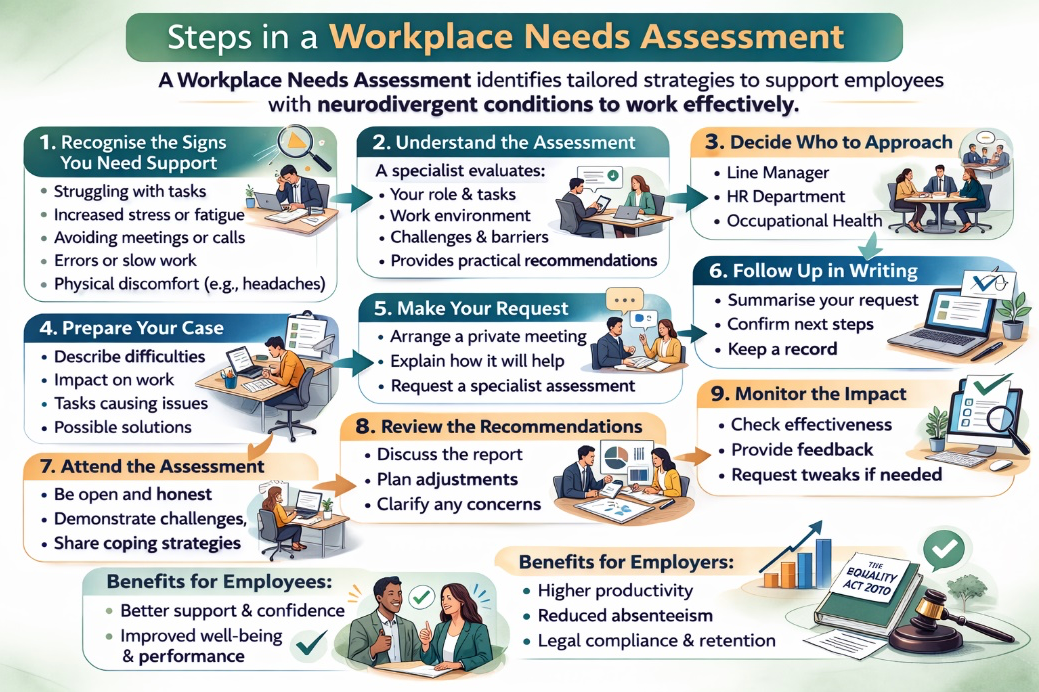
What happens before and during an assessment?
1. Recognise the Signs You Need Support
- Struggling with tasks
- Increased stress or fatigue
- Avoiding meetings or calls
- Errors or slow work
- Physical discomfort (e.g., headaches)
2. Understand the Assessment
A specialist evaluates:
- Your role & tasks
- Work environment
- Challenges & barriers
- Provides practical recommendations
3. Decide Who to Approach
- Line Manager
- HR Department
- Occupational Health
4. Prepare Your Case
- Describe difficulties
- Impact on work
- Tasks causing issues
- Possible solutions
5. Make Your Request
- Arrange a private meeting
- Explain how it will help
- Request a specialist assessment
6. Follow Up in Writing
- Summarise your request
- Confirm next steps
- Keep a record
7. Attend the Assessment
- Be open and honest
- Demonstrate challenges
- Share coping strategies
8. Review the Recommendations
- Discuss the report
- Plan adjustments
- Clarify any concerns
9. Monitor the Impact
- Check effectiveness
- Provide feedback
- Request tweaks if needed